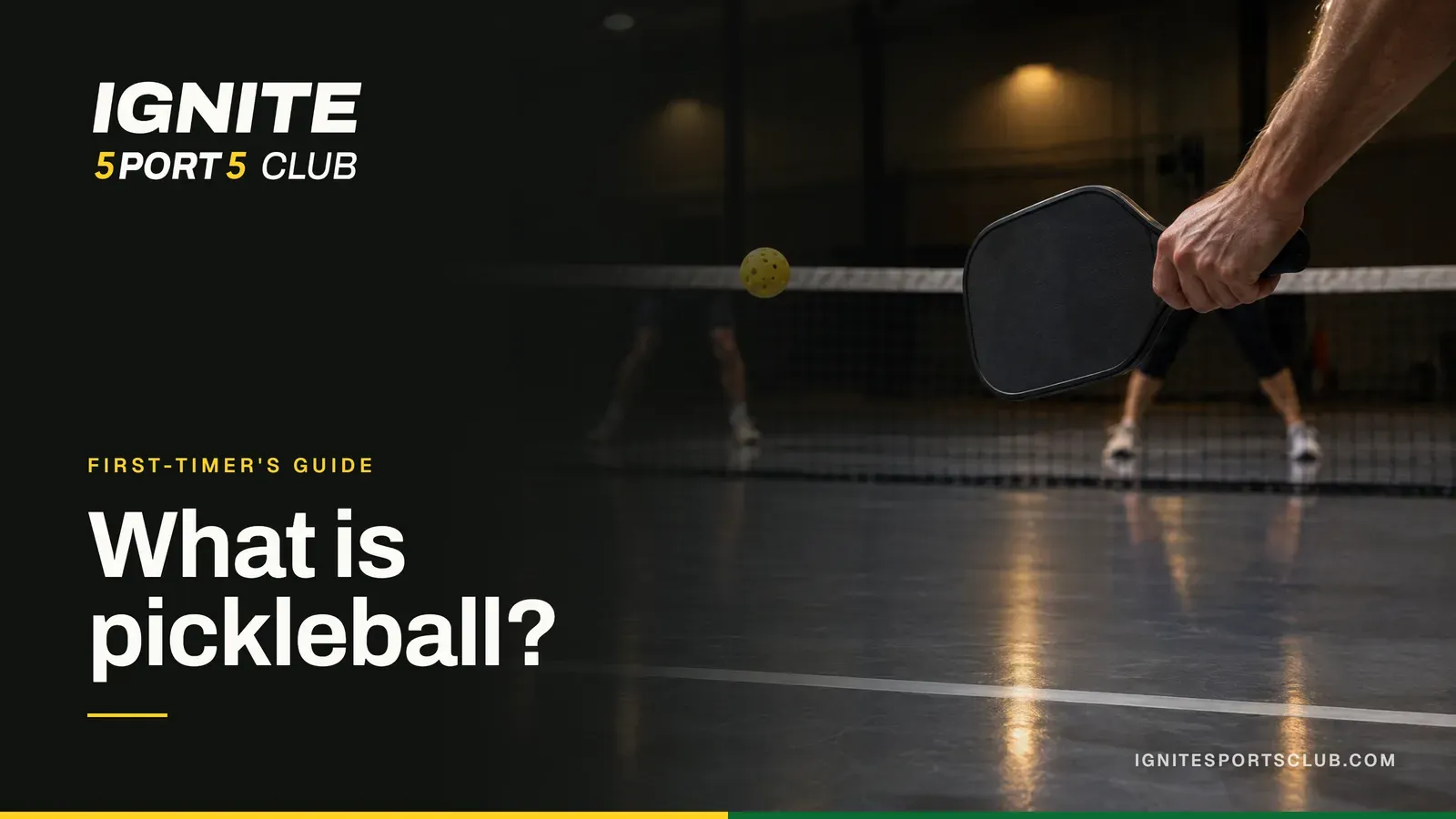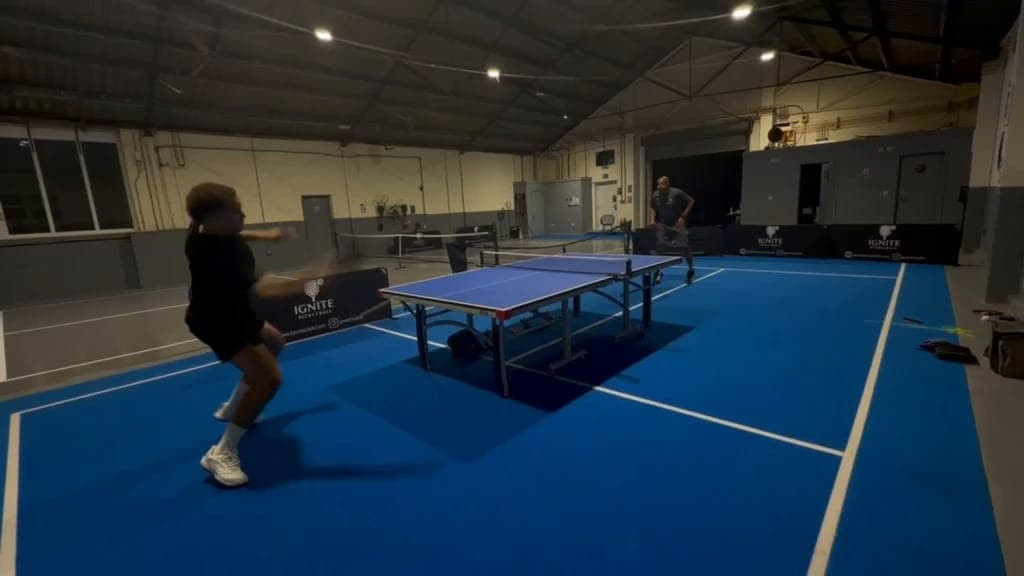

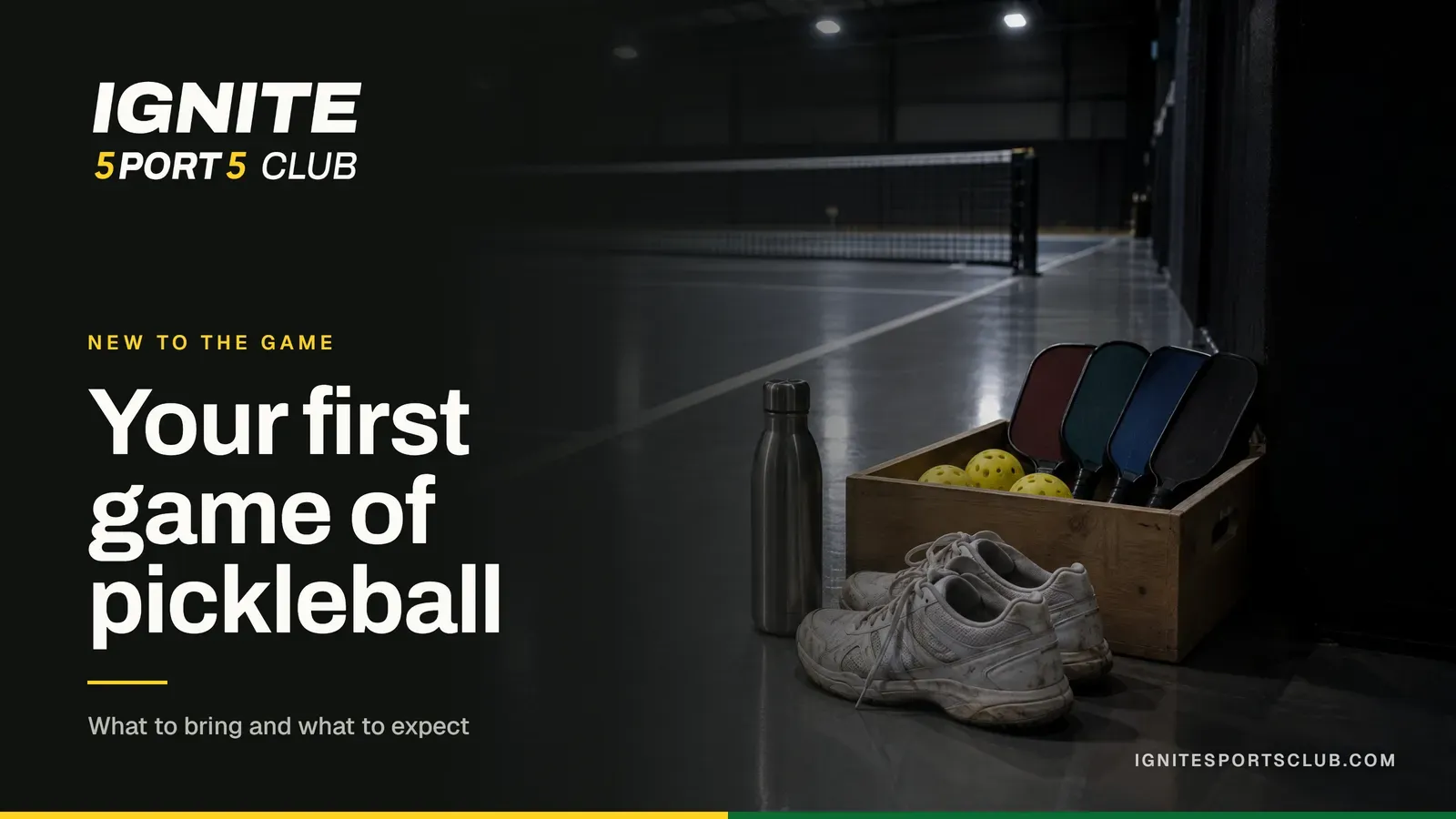
For your first game of pickleball at Ignite, all you need to pack is a pair of trainers, clothes you can move in and a drink. You will find paddles and balls next to the court. Expect a light, slow ball, a small court, a gentle underarm serve and an hour that goes much faster than you think.
This guide is the practical side: what to put in your bag, what happens when you reach the hall in Ravensthorpe, how to spend the hour so it is fun from the first rally, and the small bits of court manners that nobody tells you about. If you want the rules themselves first, read our plain guide to what pickleball is and come back.
What should you bring to your first game of pickleball?
Less than you might expect. The short list:
- Trainers. You will be stepping sideways and stopping quickly, so wear something that laces up and stays on.
- Clothes you can move in. Tracksuit bottoms, shorts, a T-shirt. Nothing about pickleball needs special kit.
- A drink. Even a gentle game gets you warm, and you will want water between games.
- Your door code. It arrives by email after you book, so have it open on your phone before you set off.
What you can leave at home: a paddle and balls. We keep both next to the court, so there is nothing to buy before you know if the game is for you. Buying your own can wait until you have played a few times and know what you like.
What happens when you get to the hall?
You will find us on Netherfield Road in Ravensthorpe (WF13 3JX). You let yourself in, at any hour you have booked. Outside staffed hours there will be no staff on site, and you do not need anyone to be. Your booking emails do the job of a receptionist: they bring your entry code and explain how to get the lights on.
So the arrival goes like this. Key the code in at the door, follow the email's steps for the lights, find the paddles and balls by the court, and start.
If you are coming for the first time, check the map and directions before you leave. For more on how the code and the hours work, the 24/7 access page covers it.
How should you spend your first hour on court?
Jumping straight into a scored game is the quickest way to spend an hour picking balls up off the floor. A loose plan helps. Here is one that suits a group where nobody has played before.
First ten minutes: just hit it back and forth
Stand either side of the net, close in, and pat the ball to each other softly. No scoring, no rules. The point is to learn how the ball comes off a solid paddle, which feels nothing like a strung racket. It is lighter than you expect, and it will fly long if you swing hard.
Next ten minutes: practise the serve
Take turns serving from behind the baseline into the box diagonally opposite. Keep the swing underarm, with contact below the waist. A serve that lands in the kitchen, the strip next to the net, does not count, and that includes one that touches the kitchen line. Aim deep and steady rather than hard.
Next ten minutes: soft shots at the net
Move up to the kitchen line on both sides and try to drop the ball gently into your opponent's kitchen, so it bounces before they can reach it. These soft shots are called dinks. It is the part of the game that surprises new players most, because winning a point by hitting softer feels backwards until you try it.
The rest of the hour: play games
Now play properly. Games usually go to 11 points, and you need a two-point lead to finish. A game between beginners does not last long, which is good: you can swap partners, change ends and play several in an hour, so everyone gets a turn on each side.
What will feel strange the first time?
Our beginner's guide covers the rules. Two of them tend to feel odd in practice, even once you know them.
- Letting the return bounce. If your side served, the ball coming back has to bounce before you hit it. Volley it before it bounces and your side loses the rally. Hang back near the baseline until it lands.
- A score that stands still. In traditional scoring, only the serving side can score. Win a rally on your opponent's serve and you get no point: the serve moves to their second server, or across to your side, so a game can go several rallies with no change to the score. That is normal, not a mistake in your counting.
One habit is worth starting from your first serve: say the score out loud before you serve. It keeps everyone agreed on whose turn it is and saves the arguments later on.
Where should you stand in a game of doubles?
With four of you, you will be playing doubles, and where you stand makes a big difference. A simple starting pattern:
- Serving side: both players start at the back. The server stands behind the baseline, and the partner waits beside them, also back, because the return has to bounce before your side can hit it.
- Receiving side: the player taking the serve stands near the baseline to let it bounce. The partner usually starts up at the kitchen line, so your side is halfway to the net before the rally begins.
Once the bounces are done, the aim for both pairs is to move forward together and stand side by side at the kitchen line. From there, you can play soft shots down at your opponents' feet.
Two habits help at the net. Hold the paddle up in front of your chest, rather than down by your knee, so you are ready for a ball at your body. And keep the swing short: from that close, a big backswing is too slow and sends the ball flying long.
Do not worry about getting this right in a first game. Knowing the idea, back at the start and forward once the ball has bounced twice, is enough to make the game feel less chaotic.
How do you keep a mixed group enjoying it?
Not every group arrives with the same experience. Someone may have played tennis or badminton for years while the others have never held a racket. A few easy tweaks keep the hour fun for all of them.
- Swap partners every game. Pair the strongest player with the newest one, then rotate, so nobody spends the hour on the losing side.
- Save the smashes for later. A high ball is tempting to hit as hard as you can. Against someone on their first day, a steady return keeps the rally going and teaches them more.
- Play a short game first. A game to 5 or 7 points gets everyone through the serving order quickly before you try a full game to 11.
- Take a break between games. A minute for a drink and a chat about what worked does more for a beginner than another game straight away.
Is there any pickleball etiquette to know?
Yes, a little, and it is mostly common sense.
- A ball on the line is in. Under the rules, a ball touching any line counts as in. The one exception is a serve that touches the kitchen line, which is a fault.
- Only call it out when you are certain. USA Pickleball's sportsmanship guide asks players not to call a ball out unless they saw it clearly, and to settle any doubt in their opponents' favour.
- Finish at the net. The same guide asks players to meet at the net at the end of each game and acknowledge each other.
And one that is simply good manners in a shared hall: put the paddles and balls back by the court and leave everything tidy, so the next people find the court ready.
How long should you book for a first go?
An hour is plenty for a first go. It gives you time to warm up, try the drills above and play a few games without anyone flagging. The court is £20 an hour, and that is for the court, not for each player, so a group of four splits it.
If you enjoy it, the next booking can be longer: you can book as many hours back to back as you like. Plan around the two weekly closures: the hall cannot be booked on a Wednesday between 6pm and 7.15pm, or on a Friday between 7pm and 9pm.
When can you play your first game?
Any free hour that suits you, morning, evening or the middle of the night. Bring three friends, split the £20 four ways, run through the drills above and find out if pickleball is your game. Book the pickleball court for your first hour.